
Ground Support Equipment in Aircraft Ground Handling
Ground support equipment (GSE) in aircraft ground handling: types, functions, regulations, safety data, a case study and tips for choosing GSE.

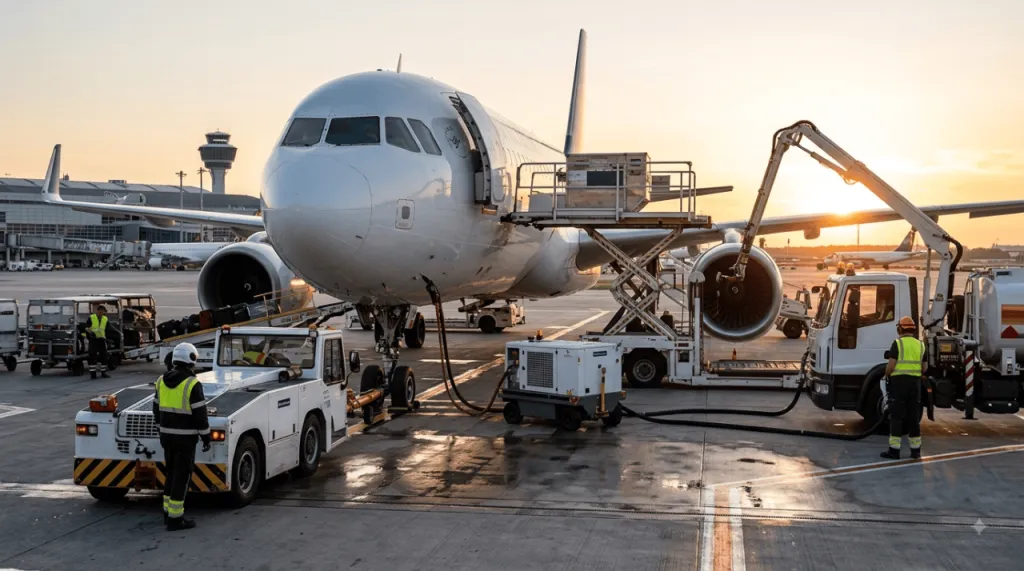
Ground Support Equipment (GSE) is all the ground equipment, both motorized and non-motorized, used to serve aircraft while they are at an airport, from landing, passenger and cargo loading and unloading, and power and fuel supply to the turnaround process before departure.
Contents
- Key Takeaways
- Introduction
- What Is Ground Support Equipment (GSE)?
- Types of Ground Support Equipment
- Supporting Data and Facts
- Case Study: GSE in Airport Operations
- Pros and Cons of Using GSE
- Practical Tips and Recommendations
- Regulations and Official References
- FAQ About Ground Support Equipment
- Conclusion
Key Takeaways
- Definition: GSE is ground support equipment used to serve aircraft on arrival and departure and during the loading and unloading of passengers, cargo and mail, as regulated in SKEP 91/IV/2008 (an Indonesian government decree).
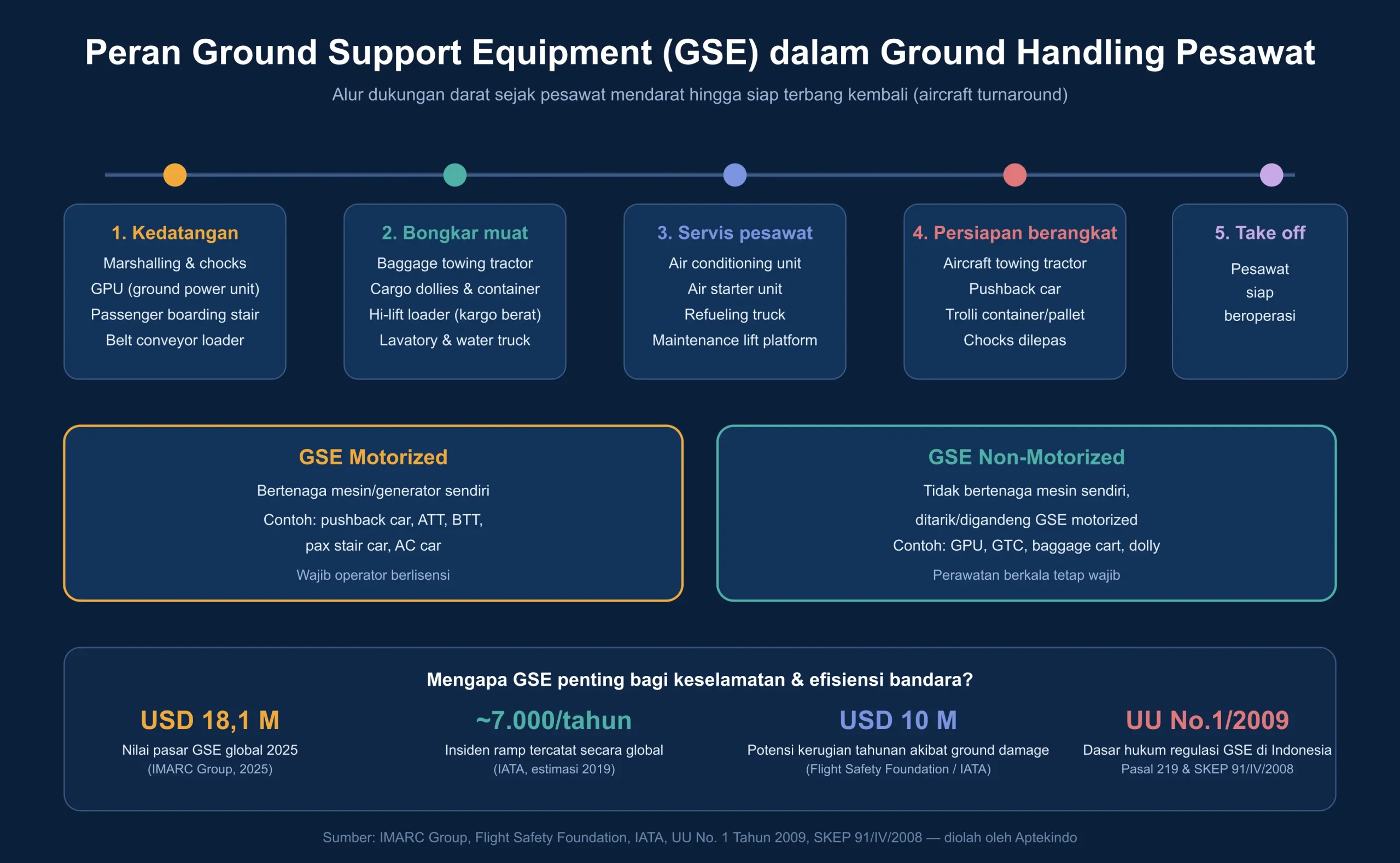
- Two main categories: motorized GSE (self-powered, for example a pushback car or aircraft towing tractor) and non-motorized GSE (towed or hitched, for example a ground power unit or baggage cart).
- Core functions: supporting ground power operations, aircraft mobility on the ground, and the loading and unloading of passengers and cargo.
- Legal basis in Indonesia: Law No. 1 of 2009 on Aviation, Articles 219 and 222, and SKEP 91/IV/2008.
- Industry scale: the global GSE market is estimated to reach USD 18.1 billion in 2025 and grow to USD 32.9 billion by 2034 (IMARC Group).
- Safety: incidents in the ramp/apron area are estimated at around 7,000 a year globally, with potential industry losses of up to USD 10 billion a year (IATA; Flight Safety Foundation).
- Operators must be certified for the type of GSE they handle, because operating errors are one of the main causes of ground damage to aircraft.
Introduction
Every time an aircraft lands, a series of ground tasks begins that is fast, precise and almost without pause: unloading passengers, unloading baggage, refueling, supplying electricity and air to the cabin, and pushing the aircraft back from the gate for its next flight. All of this is called ground handling, and none of it can happen without the support of Ground Support Equipment (GSE).
GSE often escapes public attention because it works behind the scenes, far from the spotlight of the cockpit and cabin. Yet the reliability of a GSE fleet directly determines how quickly an aircraft can get back in the air (aircraft turnaround time), how safely loading and unloading goes, and how great the risk of damage to the airframe on the ground is.
This article gives a thorough look at the role, types, regulations and supporting data for GSE, along with practical recommendations for airport operators, ground handling agents and fleet managers.
What Is Ground Support Equipment (GSE)?
Under SKEP 91/IV/2008 on Ground Service Support Equipment, GSE is defined as the aids prepared for the needs of aircraft on the ground, both on arrival and on departure, including the loading and unloading of passengers, cargo and mail.
This definition was later reinforced by Law No. 1 of 2009 on Aviation, Article 219, which treats GSE as part of the airport facilities that must be available according to operational needs.
Functionally, the role of GSE can be grouped into three main areas:
- Ground power operations: providing electrical power, compressed air and cooling air to the aircraft while its main engines are off.
- Aircraft mobility: moving the aircraft around the ground area, including pushback and towing.
- Loading operations: loading and unloading passengers, baggage, cargo and mail.
Who Operates GSE?
GSE operators are ground handling staff who hold a license for the type of equipment they handle, as required by Article 222 of Law No. 1 of 2009 for every airport employee directly involved in operating and maintaining airport facilities. This requirement applies to both motorized and non-motorized GSE, since even the smallest operating error can lead to a collision with the aircraft body.
Where and When Is GSE Used?
GSE operates in the apron or ramp area, the aircraft parking zone near the terminal, from the moment the aircraft stops at its parking stand until it is pushed back out to taxi. Speed, accuracy and efficiency are the three main indicators of how well this process goes, because the time an aircraft spends parked directly affects the schedule of the next flight.
Why Does GSE Matter?
Without GSE, a modern aircraft cannot complete its turnaround on the ground by itself. Aircraft engines are generally shut down while parked to save fuel and reduce noise, so all the power, air and mobility the aircraft needs must be supplied from outside through GSE. The efficiency and reliability of GSE ultimately affect on-time performance and the operational safety of the airport as a whole.
Types of Ground Support Equipment
In general, GSE is divided into two broad categories: motorized and non-motorized.
Motorized GSE
Motorized GSE is equipment with its own source of power, either a diesel engine or an electric motor. Some examples:
- Pushback Car: a vehicle that pushes the aircraft backward from the gate before taxiing.
- Aircraft Towing Tractor (ATT): tows the aircraft in certain situations and needs an experienced operator, because aircraft weigh anywhere from tens to hundreds of tons.
- Baggage Towing Tractor (BTT): pulls strings of baggage carts and cargo dollies from the terminal to the aircraft.
- Passenger Boarding Stair (PBS) / Ambulift: helps passengers get on and off the aircraft, especially at airports without jet bridges (garbarata).
- Belt Conveyor Loader / High Lift Loader: loads and unloads baggage and cargo, including heavy cargo on wide-body aircraft.
- Air Conditioning (AC) Car: supplies cool air to the cabin while the aircraft engines are off.
Non-Motorized GSE
Non-motorized GSE has no power source of its own and is generally towed by motorized GSE. Examples:
- Ground Power Unit (GPU): supplies AC/DC electricity to aircraft systems.
- Ground Turbine Compressor (GTC) / Air Starter Unit (ASU): provides pressurized air to help start aircraft engines.
- Baggage Carts and Cargo Dollies: containers that carry baggage and cargo, towed by a BTT.
- Chocks: blocks placed against the landing gear wheels so the aircraft does not move while parked.
- Towbar: the rod that connects the aircraft and the towing tractor during towing.
This split into two categories matters operationally because it determines the type of operator license, the maintenance schedule and the safety procedures that apply to each piece of equipment.
Supporting Data and Facts
The following data illustrates the scale and urgency of GSE's role in the global and national aviation industry:
- The global GSE market is estimated to reach USD 18.1 billion in 2025 and is projected to grow to USD 32.9 billion by 2034, at an annual growth rate (CAGR) of about 6.85 percent, driven by rising air traffic and investment in electrifying GSE fleets.
- North America holds the largest share of the global GSE market, over 33 percent in 2025, followed by Asia-Pacific, which is growing fastest as airports expand.
- According to an IATA estimate released in 2019, there are about 7,000 incidents and accidents in the ramp area every year globally, equal to one incident per 1,000 departures, with about 243,000 people injured in ground handling incidents each year.
- The Flight Safety Foundation estimates that ramp accidents cost major airlines worldwide at least USD 10 billion a year, covering damage to aircraft, facilities and ground support equipment.
- IATA projects that the cost of damage from ground damage could reach USD 10 billion a year by 2035 if there is no significant improvement, while process efficiency and new technology could save up to USD 2 billion a year by 2030.
- In IATA's 2025 safety report, ground damage remained one of the most common types of accidents, alongside tail strikes, landing gear events and runway excursions, with airport facilities contributing to 16 percent of all recorded aviation accidents.
These figures show that GSE is not just a technical aid but an aviation safety component with financial and operational impact on a large scale.
Case Study: GSE in Airport Operations
As an illustration of real-world use, a ground handling agent at a domestic airport in Indonesia operates a GSE fleet of more than 300 motorized units handled by trained operators, with thorough maintenance ranging from routine servicing to overhauls according to the manufacturer's recommendations (Original Equipment Manufacturer).
A fleet of this size shows how complex GSE needs are at an airport with high flight frequency, since every transiting aircraft needs a combination of several types of GSE at once within a short time.
In practice, a single turnaround cycle for a narrow-body aircraft usually involves more than five types of GSE at the same time: a GPU for electrical power, an AC car for cabin cooling, a belt loader for baggage, a passenger stair for passengers and a pushback car for departure.
This case study shows that ground handling efficiency depends not only on the number of GSE units but also on schedule coordination, operator readiness and the reliability of fleet maintenance.
Pros and Cons of Using GSE
Pros:
- Speeds up aircraft turnaround, so flight schedules run more on time.
- Reduces dependence on aircraft engines while parked, which saves fuel and lowers emissions.
- Improves the safety of passengers and cargo through equipment designed specifically to aviation standards.
- Supports operational flexibility for small and large airports alike, according to traffic needs.
Cons or challenges:
- The initial investment and maintenance costs of GSE are relatively high, especially for motorized units and heavy cargo equipment.
- The risk of ground damage remains if operators are poorly trained or safety procedures are not followed consistently.
- Most conventional GSE still runs on fossil fuel, so it contributes to emissions in the airport area.
- The availability of spare parts and certified technicians for certain brands can be a problem in some regions.
READ ALSO: How Life Cycle Assessment Helps a Company Reach Sustainability
Practical Tips and Recommendations
- Make sure operator certification matches the type of GSE. Each piece of equipment has different characteristics and risks, so specific training is far more effective than general training.
- Set up a preventive maintenance schedule, not just repairs after something breaks, to reduce the risk of equipment failure during peak operations.
- Use data and an incident reporting system, such as those recommended in the IATA Safety Audit for Ground Operations (ISAGO) program, to identify risk patterns early.
- Consider a gradual transition to electric or hybrid GSE for high-volume units such as GPUs and tow tractors, in line with the electrification trend that dominates global GSE market growth.
- Bring in technical consultation when choosing equipment, because capacity, compatibility with aircraft types and airport field conditions strongly affect the right GSE specification.
Regulations and Official References
Some official references relevant to GSE management in Indonesia and to international standards:
- Law No. 1 of 2009 on Aviation, especially Article 219 on airport facilities and Article 222 on the licensing requirement for personnel who operate and maintain airport facilities.
- SKEP 91/IV/2008 on Ground Service Support Equipment (Ground Support Equipment), the reference for the definition and classification of GSE in Indonesia.
- IATA Ground Operations Safety Program, including safety performance indicators based on ground incident data (Ground Occurrences), which you can read more about on IATA's official site at iata.org/en/programs/ops-infra/ground-operations/safety.
- IATA Safety Audit for Ground Operations (ISAGO), the international audit standard for ensuring the quality and safety of ground handling at airports around the world.
FAQ About Ground Support Equipment
What is Ground Support Equipment (GSE)? GSE is all the ground equipment used to serve aircraft while they are at an airport, covering electrical power, aircraft mobility, and the loading and unloading of passengers and cargo.
What is the difference between motorized and non-motorized GSE? Motorized GSE has its own source of power, such as an engine or electric motor, for example a pushback car or towing tractor. Non-motorized GSE has no power source and must be towed by motorized GSE, for example a ground power unit or baggage cart.
Who is allowed to operate GSE at an airport? Only personnel who hold a license for the type of GSE they handle, as required by Article 222 of Law No. 1 of 2009 on Aviation.
Why does GSE matter for aviation safety? Because errors in operating GSE are one of the main causes of ground damage to aircraft, which according to IATA and the Flight Safety Foundation creates potential losses of billions of dollars a year worldwide.
How long does an aircraft turnaround involving GSE take? The duration varies with aircraft type and airport policy, but it generally ranges from 25 to 60 minutes for a domestic narrow-body aircraft, with GSE working simultaneously to speed up the process.
What regulations govern GSE in Indonesia? The main regulations are Law No. 1 of 2009 on Aviation, Articles 219 and 222, and SKEP 91/IV/2008 on Ground Service Support Equipment.
Conclusion
Ground Support Equipment is the backbone that lets an aircraft function at its best while on the ground. From supplying electrical power and pushing the aircraft back from the gate to making sure baggage and cargo move safely, all of it depends on the reliability, maintenance and competent operators of GSE.
With a global market that keeps growing and real safety risks in the ramp area, investing in quality GSE and complying with regulations is no longer optional. It is a basic need for every airport and ground handling agent that wants to protect both efficiency and operational safety.
Understanding how important ground support is to safe and efficient operations, Aptekindo is here as a partner ready to help with your consultation, procurement and operational support equipment solutions.
Our team is ready to discuss your specific field needs and help you find a solution that fits safety and work efficiency standards. For further consultation, contact us:
- Phone: 021-52920671
- Email: [email protected]
The Aptekindo team is ready to answer your technical needs and discuss the solutions most relevant to your operational conditions in the field.
References:
- Law No. 1 of 2009 on Aviation.
- SKEP 91/IV/2008 on Ground Service Support Equipment.
- IMARC Group, Global Ground Support Equipment Market Statistics, 2025.
- Grand View Research & Precedence Research, Ground Support Equipment Market Report, 2025-2026.
- IATA, Ground Ops Safety Program and IATA 2025 Safety Report.
- Flight Safety Foundation, Ground Accident Prevention (GAP) Program.