RANS Stock Plunges: A Full Analysis for Investors
RANS stock plunge after its IPO: causes, official IDX data, pros and cons, and practical tips for investors after two sharp corrections in July 2026.


RANS stock (PT Rans Entertainment Indonesia Tbk) plunged 10.53% to Rp204 on July 13, 2026, and corrected again by 6.96% to Rp214 on July 24, 2026, driven by post-listing profit taking, foreign selling pressure and the resignation of one of the company's directors. A 41.6% drop in net profit in 2025 added to investor concern about the issuer's fundamentals.
Contents
- Key Summary
- Introduction
- Full Timeline: When and How Far Did RANS Shares Fall?
- Why Did RANS Shares Plunge? Analysis of the Main Causes
- Supporting Official Data and Facts
- Quotes From Analysts and Official Sources
- Case Study: Comparison With Other IPOs Under the Same Underwriter
- Pros and Cons of RANS Stock for Investors
- Practical Tips and Recommendations for Investors
- FAQ About RANS Stock
- Conclusion
Key Summary
- What: The shares of entertainment issuer RANS suffered two sharp post-IPO corrections: -10.53% (July 13, 2026) and -6.96% (July 24, 2026).
- Who: PT Rans Entertainment Indonesia Tbk, controlled by Raffi Ahmad and Nagita Slavina, trading under the ticker RANS on the Indonesia Stock Exchange (IDX, or BEI).
- When: Over the course of July 2026, soon after the initial listing on July 10, 2026.
- Why: A combination of profit taking after a sharp rally, selling pressure from foreign investors, the resignation of Director Grandy Prajayakti and weaker 2025 financial performance (net profit down 41.6%).
- Impact: Despite the price correction, liquidity remains high, with daily transaction values reaching hundreds of billions of rupiah, a sign that market interest is still strong despite the volatility.
- Recommendation: Investors are advised to judge RANS on its long-term fundamentals (Cipungland, Slavina, the AI ecosystem), not just the euphoria around a public figure's name.
Introduction
The initial public offering (IPO) of PT Rans Entertainment Indonesia Tbk, ticker RANS, on the Indonesia Stock Exchange on July 10, 2026 briefly became one of the highlights of Indonesia's capital market.
Controlled by celebrity couple Raffi Ahmad and Nagita Slavina, who have a combined following of more than 155 million across digital platforms, the stock soared 34.12% on its debut, from the offer price of Rp170 to Rp228, and touched an all-time high of Rp314 on July 16, 2026.
But the euphoria did not last. Just days after the listing, RANS shares fell sharply even as the Jakarta Composite Index (IHSG) strengthened, raising concern among retail investors who had just bought in at high prices.
This article offers a complete analysis, based on official data, of why RANS shares plunged, the company's fundamentals and practical recommendations for investors who want to decide rationally.
Full Timeline: When and How Far Did RANS Shares Fall?
Phase 1: First-Day Listing Euphoria (July 10, 2026)
RANS officially began trading on the IDX on Friday, July 10, 2026, at a final offer price of Rp170 per share. In the opening session the price jumped straight to Rp228, a gain of 34.12%, and closed at the upper auto-reject (ARA) limit. The listing was attended by a number of business figures and public personalities, including Garibaldi Thohir, Anindya Bakrie and Ariel NOAH, reflecting the high level of market attention on this issuer.
Phase 2: The Rally Continues to Its Peak (July 14-16, 2026)
After touching a low of Rp188 on July 14, 2026, RANS shares reversed and continued their rally to an all-time high of Rp314 on July 16, 2026, almost double the IPO price.
Phase 3: First Sharp Correction (July 13, 2026)
With the IHSG up 1.92% to 6,037.84, RANS shares instead weakened 10.53% to Rp204 per share. That morning's session had in fact seen RANS open at Rp280 and touch an intraday high of Rp282. Trading value that day was recorded at about Rp820.6 billion, with volume reaching 3.4 billion shares and a transaction frequency topping 694,590, making RANS one of the most actively traded stocks of the day.
Phase 4: Second Sharp Correction (July 24, 2026)
At the close of trading on Friday, July 24, 2026, RANS shares plunged again, by 6.96% or 16 points, to Rp214. The price opened lower at Rp226, briefly rose to Rp228, then was pushed down to a daily low of Rp210. The correction coincided with two important events: the announcement that Director Grandy Prajayakti was resigning for personal reasons, and foreign net selling worth Rp5.93 billion that dominated the market that day.
Phase 5: Consolidation and Rebound (Late July to August 2026)
Entering late July 2026, RANS shares traded in a range of Rp206 to Rp214, reflecting a consolidation phase after two sharp corrections. In early August 2026, a number of analysts noted that the share price had strengthened again compared with the initial offer price, although the rise was seen as driven more by market sentiment than by any improvement in fundamentals.
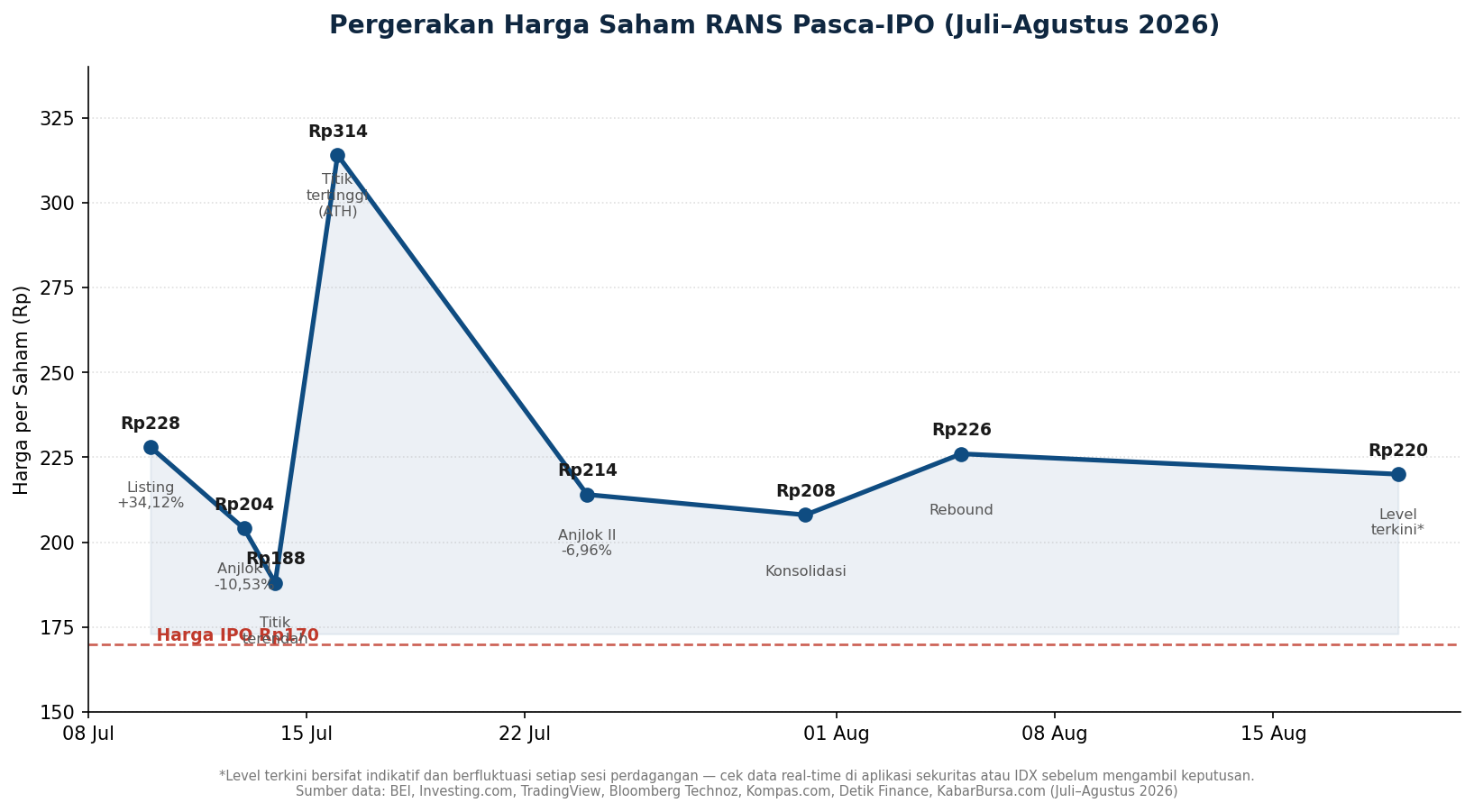
Infographic: RANS stock price movement after the IPO, from the offer price of Rp170 to the consolidation phase. Data sources: IDX, Investing.com, TradingView, Bloomberg Technoz, Kompas.com, Detik Finance, KabarBursa.com.
Why Did RANS Shares Plunge? Analysis of the Main Causes
1. Profit Taking After the Rally
The 34.12% gain on the first day of listing, plus a continued rally to Rp314, created a large floating gain for investors who were allocated shares at the IPO price of Rp170. When the price reached a high psychological level, some investors naturally cashed in, triggering short-term selling pressure. This pattern is common in IPO stocks that jump sharply in the first days of trading.
2. Foreign Investor Selling Pressure
In the second correction in late July 2026, the data showed foreign sell value reaching Rp5.93 billion, far outweighing foreign buy value on the same day. Dominant foreign selling is often an indicator of short-term negative sentiment toward a stock, especially for a newly listed issuer with no long track record in the market.
3. Internal Dynamics: A Director's Resignation
The resignation of Director Grandy Prajayakti, which coincided with the sharp correction on July 24, 2026, also fueled market speculation, although the company said the resignation was for personal reasons. Changes on the board of directors, especially at a company that has just done its IPO, tend to be met with caution by investors because they can affect management stability and the execution of business strategy.
4. Weaker Financial Performance
According to the official prospectus issued before the IPO, RANS's 2025 revenue was Rp353.38 billion, down 13.91% from Rp410.50 billion in 2024. Net profit for the year fell even more steeply, by 41.6%, from Rp97.07 billion in 2024 to Rp56.69 billion in 2025.
The decline was attributed to rising expansion costs for new business ecosystems (Cipungland, the Slavina beauty line and AI projects) whose monetization has not yet fully kicked in. The combination of a premium valuation (a price-to-earnings, or P/E, ratio of roughly 30 to 38 times) and a declining profit trend is one of the fundamental reasons behind RANS's price volatility.
5. "Hot IPO" Characteristics Prone to High Volatility
RANS shares are recorded with volatility of 3.85% and a beta coefficient of 5.03, far above the market average. This means the stock's price moves much more erratically than the IHSG overall, a characteristic common in popular IPO stocks (hot IPOs) with strong retail demand but a still-limited institutional investor base.
Supporting Official Data and Facts
| Indicator | Data | Source |
|---|---|---|
| IPO offer price | Rp170/share | RANS prospectus, June 23, 2026 |
| Funds raised in the IPO | Rp429.25 billion | IDX |
| New shares offered | 2.525 billion shares (20.02% of paid-up capital) | IDX |
| First-day listing gain | +34.12% to Rp228 | IDX trading data, July 10, 2026 |
| All-time high (ATH) | Rp314 (July 16, 2026) | TradingView |
| First correction | -10.53% to Rp204 (July 13, 2026) | IDX, Bloomberg Technoz |
| Second correction | -6.96% to Rp214 (July 24, 2026) | IDX, KabarBursa.com |
| 2025 revenue | Rp353.38 billion (down 13.91% YoY) | RANS prospectus |
| 2025 net profit | Rp56.69 billion (down 41.6% YoY) | RANS prospectus |
| P/E ratio at IPO | 30-38 times | Pluang Akademi analysis |
| Volatility & Beta | 3.85% / 5.03 | TradingView |
| Dividend policy | No dividends paid | TradingView |
The allocation of IPO proceeds is also an indicator of the company's strategic direction: about 37.61% (Rp161.5 billion) is allocated to concerts and events, 19.8% (Rp85 billion) to acquiring a 51% stake in PT Rans Kosmetika Indonesia (the Slavina line), and 18.64% (Rp80 billion) to developing the Cipungland educational entertainment park, with the remainder allocated to, among other things, debt repayment and developing artificial intelligence (AI)-based business with technology partners.
Quotes From Analysts and Official Sources
Responding to the volatility in RANS's share price, Yudi Suparta, an analyst at Jaringan Media Pemuda Indonesia (JAMPI), cautioned investors against over-reading price movements. He stressed that the price gains since the IPO reflect strong market interest, but investment decisions must still rest on verified fundamental analysis, given that the company's revenue and net profit performance in 2025 actually slowed compared with the previous year.
In line with this, Muhammad Wafi, Head of Research at KISI Sekuritas, assessed RANS's valuation at IPO as premium for a company still in an expansion phase and without a consistent record of profit growth.
He also noted that retail investor interest in the stock was most likely driven by the brand awareness of Raffi Ahmad and Nagita Slavina among young people, while institutional investors tend to be more selective because RANS's creator economy business model is still relatively new in Indonesia's capital market.
According to official Indonesia Stock Exchange (IDX) data, the IHSG's 1.92% rise to 6,037.84 on July 13, 2026 ran directly opposite to the sharp correction RANS shares suffered the same day, indicating that the selling pressure on this stock was specific to the issuer and did not reflect overall market sentiment.
Case Study: Comparison With Other IPOs Under the Same Underwriter
PT Trimegah Sekuritas Indonesia Tbk, the underwriter of the RANS IPO, previously also handled several other popular IPOs on the IDX in 2026, such as CDIA (up 35% on the first day), EMAS (up 25%, hitting ARA on the first day) and SUPA (up 24.41% on the first day). RANS showed a similar pattern: a big jump on the first day of listing, followed by high volatility in the following weeks.
This case study offers an important lesson for investors: "hot IPO" stocks with sharp first-day gains tend to attract short-term traders who play the momentum, rather than purely long-term investors who judge fundamentals.
As a result, once the euphoric momentum fades, selling pressure from short-term traders can trigger a sharp correction, as happened with RANS just days after listing.
Pros and Cons of RANS Stock for Investors
Pros
- A strong personal brand and a large audience base. Raffi Ahmad and Nagita Slavina have a combined following of more than 155 million across digital platforms, giving the company a content distribution and monetization engine that conventional media issuers on the IDX would find hard to match.
- A diversified business model. RANS does not rely on digital content alone. It has also expanded into physical assets (Cipungland), a beauty line (Slavina), concerts and events, and the development of artificial intelligence (AI) technology.
- High trading liquidity. Daily transaction values in the hundreds of billions of rupiah show that the stock is easy to trade, an important factor for investors who value flexibility in entering and exiting positions.
- A market segment rarely found on the IDX. The combination of media, entertainment, intellectual property (IP) and a digital ecosystem makes RANS relatively unique compared with conventional media issuers, which generally depend on advertising revenue.
Cons
- Declining financial performance. Revenue and net profit in 2025 both fell from the year before, pointing to monetization challenges amid business expansion.
- Premium valuation. A P/E ratio of 30 to 38 times at the IPO price is high for a media company with a declining profit trend, so the share price depends heavily on future growth expectations rather than historical earnings.
- High volatility and beta. With a beta above 5, RANS's price moves far more erratically than the market overall, raising the risk for investors with low risk tolerance.
- No dividends. For investors who prioritize passive income from dividends, RANS is currently not a suitable choice.
- A very short track record as a public company, so its price patterns and corporate governance have not been tested over the long term.
Practical Tips and Recommendations for Investors
- Focus on fundamentals, not the sentiment around public figures. The popularity of Raffi Ahmad and Nagita Slavina can drive short-term buying interest, but the sustainability of the share price is ultimately determined by the company's ability to deliver consistent revenue and profit growth.
- Track the delivery of expansion projects. Progress at Cipungland, the Slavina beauty line and the AI development partnership are key indicators of whether the IPO proceeds really produce new sources of revenue.
- Watch foreign transaction data and daily volume as indicators of short-term sentiment, but do not make them the only basis for an investment decision.
- Apply strict risk management, given that this stock's volatility and beta are far above the market average. Consider position sizes that are proportionate to your total portfolio.
- Avoid impulsive decisions driven by price euphoria. Whether the price surges or plunges sharply, it is important to go back to the official financial statements and the disclosures published through official IDX channels.
- Use official data sources such as the disclosures on the Indonesia Stock Exchange website (idx.co.id) and the financial statements the company publishes to verify any news circulating in the market.
FAQ About RANS Stock
What is RANS stock? RANS stock is the shares of PT Rans Entertainment Indonesia Tbk, a media and entertainment issuer controlled by Raffi Ahmad and Nagita Slavina, listed on the Indonesia Stock Exchange under the ticker RANS since July 10, 2026.
When did RANS stock start to plunge? RANS shares first corrected sharply on July 13, 2026, falling 10.53% to Rp204, just three days after the initial listing. The second sharp correction came on July 24, 2026, down 6.96% to Rp214.
What are the main reasons RANS stock plunged? The main reasons are a combination of profit taking after a sharp rally, selling pressure from foreign investors, the resignation of one of the company's directors and the decline in the company's revenue and net profit in 2025.
Is RANS stock safe for long-term investment? The safety of an investment depends on each investor's risk profile. RANS shares have high volatility and beta, a premium valuation and declining profit performance, so they suit investors with a high risk tolerance who understand the characteristics of IP- and personal-brand-based growth stocks better than investors seeking stability or dividends.
Does RANS pay dividends? No. According to TradingView data, RANS has not paid dividends to its shareholders since listing.
How did RANS perform financially in 2025? RANS's 2025 revenue was Rp353.38 billion, down 13.91% from 2024. Net profit fell more sharply, by 41.6%, from Rp97.07 billion to Rp56.69 billion, because of rising expansion costs for new businesses.
Where can investors verify official RANS data? Investors can verify official data through the disclosures on the Indonesia Stock Exchange website (idx.co.id), the company's prospectus and the financial statements published by PT Rans Entertainment Indonesia Tbk.
Conclusion
The plunge in RANS shares in July 2026 was not a single phenomenon but the result of several interacting factors: excessive price euphoria in the first days of listing, profit taking, foreign selling pressure, internal management dynamics and weaker 2025 financial performance amid a premium valuation.
For investors, the sharp volatility of a stock built on the popularity of a public figure, like RANS, is an important reminder that a big name and a large social media following do not automatically guarantee share price stability or the sustainability of a company's fundamental performance.
Going forward, the direction of RANS shares will depend heavily on real execution of the expansion projects funded by the IPO proceeds, from Cipungland and the Slavina beauty line to AI-based business development.
Investors interested in this stock are advised to keep watching the official financial statements, IDX disclosures and the progress of project delivery, rather than simply following short-term market sentiment. With a disciplined, data-based approach, investors can make more rational decisions amid RANS's high volatility.