
How AI Chooses Which Websites to Cite: E-E-A-T and GEO
See how AI chooses websites to cite, from Google AI Overview to ChatGPT and Perplexity, with an E-E-A-T and GEO guide backed by official data.


Contents
- Key Takeaways
- Introduction
- What Is AI Source Selection?
- Who Decides How This Process Works?
- When and Where Does AI Make This Selection?
- Why Doesn't AI Choose All Websites Equally?
- How Does AI Evaluate and Choose Websites? (Full Breakdown)
- Supporting Data and Facts
- Quotes From Official Sources and Trusted Platforms
- Case Studies and Examples
- Pros and Cons of AI Source Selection
- Practical Tips and Recommendations
- Infographic
- FAQ (Frequently Asked Questions)
- Conclusion
AI chooses websites as references based on five main factors: semantic relevance to the user's question, the strength of E-E-A-T signals (experience, expertise, authoritativeness, trustworthiness), content structure that is easy to scan, verifiable factual data, and freshness of information. The clearer and more verifiable a page is, the better its chance of being cited by an AI engine.
Key Takeaways
- AI does not pick websites at random. Systems such as Google AI Overview, ChatGPT Search, Perplexity and Gemini assess credibility, relevance and content structure before citing a page.
- E-E-A-T (Experience, Expertise, Authoritativeness, Trustworthiness) remains the main evaluation framework, even though it was originally designed for traditional search engines.
- Content structure that is easy to scan (clear headings, explicit answers at the start of paragraphs and concise points) improves the odds of being cited by AI.
- Verifiable data, statistics and quotations have been shown empirically to raise content visibility in generative search engines by tens of percent.
- Google's AI Overview now appears in around half of all searches, making GEO (Generative Engine Optimization) as important as traditional SEO.
- Not every site cited by AI ranks at the top of organic search results, which points to new selection signals beyond conventional rankings.
Introduction
The way search engines work has changed fundamentally. In the past, users typed in keywords and chose for themselves which link to open. Now a growing number of direct answers are served by artificial intelligence systems, from Google AI Overview, ChatGPT Search, Microsoft Copilot and Gemini to Perplexity. Instead of showing ten blue links, these engines summarize an answer and list a small number of sources as references.
This shift raises an important question for website owners, content writers and digital marketers: how does AI actually decide which sites deserve to be used as references, and which to ignore?
This article takes a thorough look at the mechanism behind AI source selection, supported by official data, academic research and real examples. It also offers practical guidance so your content has a better chance of being cited, by conventional search engines and by AI-based generative search engines alike.
What Is AI Source Selection?
AI source selection is the process in which a generative artificial intelligence system, such as the large language models (LLMs) behind Google AI Overview, ChatGPT or Perplexity, evaluates, ranks and chooses particular web pages as the basis for the answer shown to the user.
The process generally runs in two stages:
- Retrieval stage: the system pulls a set of candidate pages from the search index that are relevant to the user's query.
- Synthesis stage: the language model reads those candidates, then composes a coherent answer while choosing which parts deserve to be cited as sources.
Research from Princeton University together with IIT Delhi, which introduced the term Generative Engine Optimization (GEO), explains that generative engines tested five query domains, using Google Search to retrieve the top five sources per query, before the language model composed a full answer with its citations.
Who Decides How This Process Works?
The source selection process is determined by the search engine providers and the AI models themselves, not by a single uniform algorithm. Each platform takes a different approach:
- Google AI Overview uses the Gemini model, integrated with Google's traditional search ranking systems, including E-E-A-T signals from the Search Quality Rater Guidelines.
- ChatGPT Search and Perplexity rely on a combination of real-time web search results and the reasoning ability of the language model to judge the credibility of sources.
- Copilot (Microsoft Bing) draws on the Bing index, which has long applied signals of domain authority and content quality.
Although the mechanisms differ, nearly all of these platforms follow the same basic principle: answers must be accurate, accountable and drawn from trustworthy sources.
When and Where Does AI Make This Selection?
Source selection happens in real time, every time a user asks a question, not once and for all. That means a page cited by AI today may not be cited next week if a new source is judged more relevant, fresher or more credible.
According to data compiled by several SEO research firms in 2026, Google's AI Overview now appears on roughly 48 to 50 percent of all search queries in the United States, up sharply from around 6 to 18 percent in early 2025. That means the chance of content being cited directly by AI is now far higher than a year earlier, and it also signals that competition for these "citation slots" is getting tougher.
Why Doesn't AI Choose All Websites Equally?
Large language models have limited room in an answer: an AI summary usually cites only a few sources out of thousands of potentially relevant pages. So the system has to be strict in its selection, for several main reasons:
- Avoiding factual errors. Generative AI steers clear of sources that could produce wrong or misleading answers, so factual accuracy is the strictest first filter.
- Keeping answers efficient. Models are designed to give concise answers, so only the most information-dense and easily extracted content is chosen.
- Raising user trust. Sources with a reputation and transparent authorship are considered safer to recommend to users.
How Does AI Evaluate and Choose Websites? (Full Breakdown)
1. Semantic Relevance, Not Just Keywords
Generative AI engines assess the meaning behind a query, not just literal keyword matches. A page that covers a topic comprehensively and answers follow-up questions has a better chance of being cited, because AI tends to choose sources that can meet the full information need.
2. The Strength of E-E-A-T Signals
E-E-A-T stands for Experience, Expertise, Authoritativeness and Trustworthiness, the framework Google uses in its Search Quality Rater Guidelines to assess content quality. Google officially added the "Experience" element in late 2022 to judge whether content was created by someone with real, direct experience of the product, place or situation being discussed.
Of the four elements, trust is stated to be the most important indicator of page quality, because without trust, a piece of content's experience and expertise matter less to the evaluation system. AI-based search engines have now adopted this principle too, since they face the same risk: serving users wrong information.
3. Content Structure That Is Easy to Scan and Extract
Based on various content format studies summarized by GEO practitioners in 2026, the types of content AI Overview cites most often include structured FAQ sections, numbered lists with a short explanation for each point, dense and accurate definitions, and data accompanied by context for interpreting it. These formats make it easy for a language model to extract an answer without having to "retranslate" a complicated sentence structure.
4. Verifiable Data, Statistics and Quotations
GEO research from Princeton University and IIT Delhi, presented at the ACM SIGKDD 2024 conference, found that certain methods, such as adding statistics, citing sources and inserting direct quotations, can significantly increase content visibility in generative search engines.
The study tested around 10,000 queries across nine datasets, and found that a page that started out in fifth place in the search results could see a very large jump in citation visibility once optimized. The researchers call this the equalizer effect, because even lower-authority sites can move up if their content is optimized in the right way.
Interestingly, the same study found that old SEO tactics such as keyword stuffing actually hurt performance in generative search engines, because modern AI prefers natural language, entity richness and topical depth over the rigid repetition of phrases.
5. Freshness and Consistency of Information
Pages that are updated regularly and reflect current data are judged more worthy of being used as references, especially for fast-changing topics such as technology, health and public policy. Consistent terminology, meaning the same terms used repeatedly across a page, also helps AI models identify an article's main entities clearly, so the topic is not ambiguous when summarized.
6. Domain Authority vs. Individual Page Quality
One important finding in 2026 is that not every source cited by AI Overview also ranks in the top 10 of organic search results. Some studies recorded around 76 percent overlap between the URLs cited by AI Overview and the organic top 10, while other studies recorded a far lower figure, around 17 percent. This difference shows that classic domain authority is still relevant, but is no longer the only deciding factor, because answer quality at the individual page level now carries its own weight.
Supporting Data and Facts
Here is some official data and research relevant to this topic:
- AI Overview coverage: Google has officially stated that AI Overview now appears on around 50 percent of search queries in the United States as of early 2026, reaching more than 2 billion monthly users in more than 200 countries and 40 languages.
- Rapid growth: AI Overview coverage jumped from about 6.49 percent of queries in January 2025 to about 48 percent in March 2026, growth of nearly eight times in 15 months, according to industry tracking by BrightEdge.
- Impact on organic clicks: Organic click-through rate (CTR) has reportedly fallen significantly, with the drop ranging from about 15 to 61 percent depending on the methodology and the industry studied.
- Effectiveness of GEO optimization: The Princeton and IIT Delhi study (Aggarwal et al., 2024) recorded an increase in AI citation visibility of up to 30 to 40 percent on the Position-Adjusted Word Count metric after certain content optimization strategies were applied.
- Gap with organic rankings: Some research recorded that only about 17 percent of sources cited by AI Overview also rank in the organic top 10, which suggests a new selection system that is not entirely identical to traditional ranking algorithms.
Quotes From Official Sources and Trusted Platforms
The official Google Search Central blog explained the reason for adding the "Experience" element to the content quality evaluation framework as follows (paraphrased from Google's official statement, December 2022): Google wants to know whether a piece of content was produced with a certain level of experience, for example from using a product firsthand, visiting a place, or the author's personal experience with the topic discussed.
Meanwhile, Google's Search Quality Rater Guidelines state explicitly that trust is the most important member of the E-E-A-T family, because an untrustworthy page will still be rated low even if it appears experienced, expert or authoritative.
The academic paper that introduced the term Generative Engine Optimization notes that as large language models become the main interface for accessing information, understanding how to optimize content for those models becomes crucial for content creators (Aggarwal et al., 2024).
Case Studies and Examples
Example 1: An Educational Article With an FAQ Structure. A health education site that changed its articles from long-form essays to a question-and-answer (FAQ) structure, with a short answer at the start of each section, saw more appearances in AI Overview for informational queries. This change is consistent with the finding that structured FAQ is one of the formats AI Overview cites most often, according to GEO practitioners.
Example 2: Adding Statistics and Source Citations. Based on a simulation of the methods in the Princeton GEO study, a page that started in the middle of the search results can see a very large jump in citation visibility after adding concrete statistics and citing trusted sources in its content, which is evidence that the quality of data-backed argument can make up for a lack of domain authority.
Example 3: A Product Page With a Clear Author Bio. A local business website that equips each article with an author bio, verifiable credentials and transparent contact information tends to meet the trustworthiness standard in E-E-A-T more easily, which raises its chances of being used as a reference in both organic search and AI summaries.
Pros and Cons of AI Source Selection
Pros
- Efficiency for users: direct answers without opening many links.
- Pushes content quality up: sites are encouraged to present information that is more accurate, structured and data-based.
- Equal opportunity (equalizer effect): sites with lower domain authority still have a chance of being cited if their content quality is well optimized.
Cons
- Lower organic traffic for publishers: many users no longer click through to the source links because the answer is already presented on the search results page.
- Risk of homogenized answers: because AI tends to cite similar sources, the diversity of perspectives can shrink.
- Lack of algorithm transparency: the exact criteria each AI platform uses are not fully disclosed, so optimization is often an observation-based approach rather than a certainty.
Practical Tips and Recommendations
- Answer questions explicitly at the start of a paragraph or section. Avoid long preambles before giving the core answer.
- Use headings that reflect real user questions, not just generic titles.
- Include data, statistics and verifiable sources. Avoid unsupported claims.
- State the author's identity and credentials transparently to strengthen E-E-A-T signals.
- Update content regularly, especially for fast-changing topics.
- Use consistent terminology across the page so the main entities are easy for AI models to recognize.
- Avoid keyword stuffing. Write in natural, flowing language for human readers first.
- Build structured formats such as numbered lists, concise tables and FAQ sections to make extraction easier for AI.
- Cite credible sources in your own content. This step has been shown to build additional trust signals that may raise the chance of being cited back by AI.
Infographic
Here is a visual summary of the five main factors that influence AI's decision to choose a website as a reference:
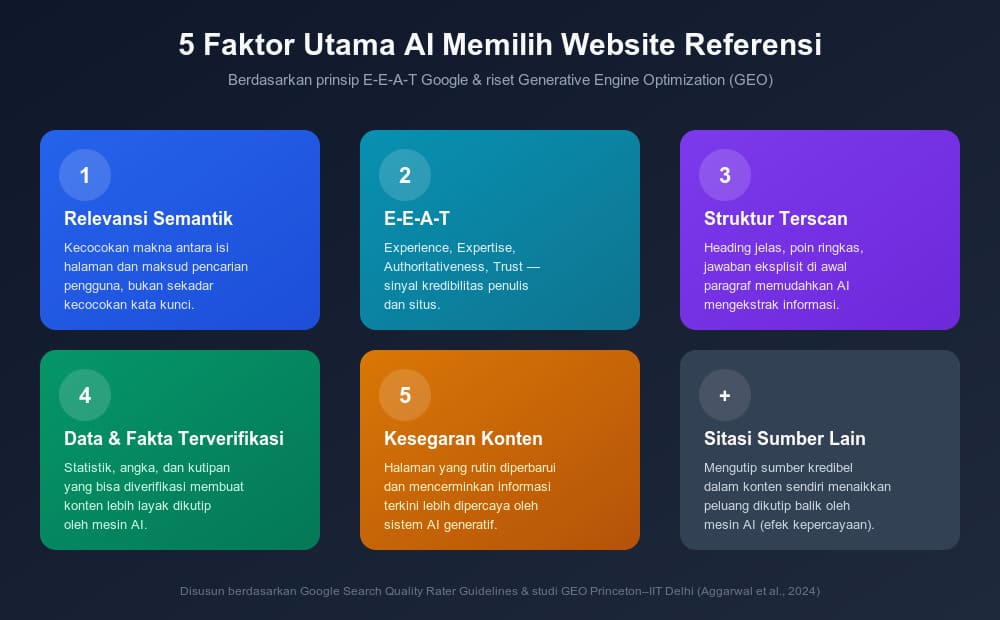
Figure: The five main factors (semantic relevance, E-E-A-T, scannable structure, verified data and content freshness) that determine whether a page deserves to be cited by generative AI.
FAQ (Frequently Asked Questions)
1. What does it mean for AI to choose websites as references? It is an automated evaluation process that assesses a page's relevance, credibility, structure and data accuracy before using it as a cited source in an AI-generated answer.
2. Who uses this AI-based source selection system? It is used by search engines and generative AI assistants such as Google AI Overview, ChatGPT Search, Microsoft Copilot, Gemini and Perplexity.
3. When does AI select its reference sources? Selection happens in real time every time a user asks a question, so the results can change over time depending on the availability of newer, more relevant sources.
4. Why isn't a high-traffic website always cited by AI? Because AI judges answer quality at the page level, not just overall domain authority. A page with a clear, verified answer can outperform a page from a large domain that is less relevant.
5. How can I improve my website's chances of being cited by AI? By applying the E-E-A-T principles, structuring content in formats that are easy to scan, including verified data, updating content regularly and keeping terminology consistent across pages.
6. What is the difference between SEO and GEO? SEO focuses on improving a page's ranking in organic search results, while GEO (Generative Engine Optimization) focuses on improving the chance of content being cited directly in answers composed by generative AI engines.
Conclusion
AI chooses websites as references through an evaluation process that combines semantic relevance, the strength of E-E-A-T signals, content structure that is easy to scan, verifiable data and freshness of information. Unlike traditional search ranking systems, which depend heavily on domain authority and backlinks, generative search engines judge answer quality at the page level in a more granular way. That opens the door for any site, large or small, to be cited, as long as its content is genuinely informative, accurate and well structured.
With AI Overview coverage now reaching around half of all Google searches, understanding and applying GEO principles is no longer an optional extra but a basic need for anyone who wants their content to stay visible in the era of AI-based search. The most sustainable approach stays the same: write for people first, with honest data and clear structure, because that kind of quality is also what AI engines end up understanding and rewarding.
References
- Google Search Central Blog: Our latest update to the quality rater guidelines: E-A-T gets an extra E for Experience (December 2022).
- Aggarwal, P., Murahari, V., Rajpurohit, T., Kalyan, A., Narasimhan, K., & Deshpande, A.: GEO: Generative Engine Optimization, ACM SIGKDD 2024 / arXiv:2311.09735 (2023 to 2024).
- 2026 SEO/GEO industry aggregate data (BrightEdge, Semrush, Seer Interactive, Conductor, Digital Applied, Position.digital) on AI Overview coverage and citation patterns.